Finishing School (part two) – lacquer
This time, we’ll cover one of the most popular finishes that European cabinets are known for – Lacquer.
Wikipedia -In a general sense, lacquer is a somewhat imprecise term for a clear or coloured wood finish that dries by solvent evaporation. It is also often a curing process as well that produces a hard, durable finish. This finish can be of any sheen level from ultra matte to high gloss, and it can be further polished as required. It is also used for “lacquer paint”, which typically denotes a paint that dries to a more than usually hard and smooth surface.
In cabinetry (and in furniture), we generally find lacquer , often called ‘shellac’, in two applications: over wood or as a color paint. It can be any of various durable natural varnishes, mostly a varnish obtained from an Asian sumac (Rhus verniciflua) —called also Japanese lacquer, or any of various synthetic organic coating (clear or colored), that dries to create a hard coating, mostly a solution of cellulose dervative (such as nitrocellulose).
Lacquered wood – generally the application of lacquer over wood is over wood veneer (sheets of wood), on slab (flat) door and in high gloss. the application of high gloss lacquer over wood veneer, gives the wood a shiny finish and creates a 3D like affect, adding depth to the wood grain look.
Pros: – rich, unique look, that a second to none, of shiny wood, magnifiying the wood design.
- easy to clean (with just a little soap and water) due to the super smooth, glass-like finish, that does not absorb anything.
Cons: – expensive. The application of the veneer, plus the glossy lacqcer, adds up to a high price.
- on dark colors, shows fingerprints.
Color laqcuer – lacquer is paint, usually sparayed over MDF boards, that dry by the evaporation of simple solvent and that contains a solid binder that dissolves in a solvent. When that process happens, a thin, hard shell is created. A few coats are applied to reach approx 5 mm. thickness.
There are three groups of lacquer textures being offered – matte, high-gloss and textured. The matte is simply that – flat paint like finish. The glossy can be at different sheen levels, but is primarily done as a high gloss. The textured lacquer is sprayed from a heated spary gun and when it meets the cold air, it forms a textured finish that is actually more durable than the other two.
Pros: – the clean, perfect look of lacquer…
- easy to clean (with just a little soap and water).
Cons: the matte finish is a bit more sustainable to scratches.
- on dark colors, shows finger prints.
LivingKitchen® – The international kitchen show at imm cologne
Even more international, even more spectacular. The big names from all segments of the kitchen sector will be represented at LivingKitchen 2013. Covering an area of 42,000 square meters, more than 180 well-known national and international suppliers will bring their latest ideas and innovations to the trade fair – from kitchen furniture and built-in appliances to sinks, fixtures, worktops, lighting and accessories. Come and experience all of the trends related to the kitchen in one place, and enjoy seven days filled with life!
Planning on attending this great 7 day event? The hall plans are now available online!
Fifty (Modern European) Shades of Grey
I recently discovere that the Fifty Shades of Grey apartment , located in the luxury Escala Building, in Seattle (okay…, the one that inspired the story and that the story takes place in) has a great European kitchen! It is not white (like in the story), but is done in exotic wood, covered with clear high gloss lacquer finish. As a matter of fact, the kitchens and vanities in the entire building, are all modern European cabintry, designed and supplied by Pedini.

This modern kitchen is in the penthouse apartment, at the Escala building, in Seattle, WA. – the inspiration for Fifty Shades of Grey story.
The Escala is not the only luxury building that is featuring Pedini kitchens. According to the company, in NYC alone, there are three luxury buildings under construction right now, that will be offering Pedini kitchens and vanities in every apartment. But Pedini is not the only modern European kitchen company that is suppliying European kitchens to luxury apartment buildings – all around the US, many high rise buildings are featuring European cabinetry. Poggenpohl, Snaidero and Bulthaup are just a few of the manufacturers that are often featured in these buildings and the developers offering them outside of metropolitan areas as well.
Many developers are realizing that the buyers (and renters) of these luxury apartments are looking for the highest quality product, with the latest technology and they usually prefer the sleek contemporary European kitchen look, over the more traditional American cabinetry.
Finishing School (part one) – Laminate
So many of you have asked me about the different finishes that are offered by the various manufacturers that I’ve decided to offer some information. I will try to assist you in choosing the right finishes and materials, in selecting your new kitchen.
We’ll start with one of the most common finishes and the most cost-effective one – laminate.
Wikipedia - Lamination is the technique of manufacturing a material in multiple layers, so that the composite material achieves improved strength, stability, appearance or other properties from the use of differing materials. A laminate is usually permanently assembled by heat, pressure, welding, or adhesives.
In the case of kitchen cabinets, the term Laminate usually refers to a plastic-like material, that gets applied onto the sub straight material of the door (mostly press board or MDF). The plastic laminate finishes that are available in the marketplace today are:
Thermofoil (or thermoplastic) - a vinyl like sheet, that is applied onto MDF doors, in various shapes, using a heat. The access vinyl, then gets cut off around the door. Usually comes in white, off white and wood colors.
Pros: – realistic ‘photo like’ appearance.
- easy to clean, as it is a vinyl finish.
Cons: - thermofoil must be produced in very large quantities, of each color.
- due to the process, the finish is only on the front and edges – the back of the door is usually white.
- over time, high temperatures (such as the one generated by self cleaning ovens) can cause the vinyl to shrink and delaminate.
Thermofoil lost some popularity in recent years, as a result of the above cons and the introduction of other attractive laminate materials.
High and Low pressure laminate (HPL and LPL) - application of printed paper-like material, over sub straight, using heat and pressure. Available in just about any color, wood colors and with or without a light texture (wood grain or other).
Pros: - very realistic ‘photo like’ appearance.
- can be produced in smaller quantities than thermofoil, at a competitive price.
Cons: – can only be used on flat surfaces, so only slab door design can have this finish.
- ‘self edging’ resulting in poor look and quality and so some type of other edging is preferable – abs (matching color thicker plastic) and aluminum edging are most common.
Thermo-structure laminate – this is a more recent form of the above laminates, but with a heavier ‘real looking’ texture. The texture is achieved by high pressure press that has textured steel plate, onto the laminate material. Available in just about any color, wood colors and with strong textures, such as wood grain and many others.
Pros: – looks more real than the ‘real thing’.
- comes with a matching edge, to create even more realistic look than the laminates above.
Cons: – can only be used on flat surfaces, so only slab door design can have this finish.
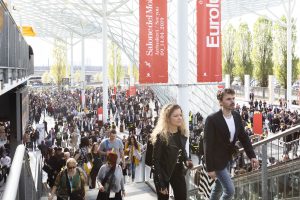
Back from Eurocucina
According to Cosmit: I Saloni 2012 have been a resounding success. A tremendous source of pride for Italy.
The eyes of the design world were focused on the 51st edition of the Saloni ( 17th to 22nd April), which encompassed 2,700 Italian and foreign exhibitors at the Salone Internazionale del Mobile, the International Furnishing Accessories Exhibition, the SaloneSatellite and the biennial EuroCucina, International Kitchen Furniture Exhibition and the International Bathroom Exhibition.
In figures: 331,649 visitors overall. 292, 370 industry professionals (3.5% up on 2011). 188,579 foreign industry professionals making up 64.5% of the total (+5.9%), plus 103,791 Italian professionals (in line with last year’s results). In addition to the industry, 6,484 members of the press attended the 2012 Saloni, 5,725 of them from countries all over the world (outside of Italy). “These are exceptional results, especially given the prevailing bleak economic climate in the run-up to the Saloni.” said Cosmit’s President, Carlo Guglielm. “However, our minds are at ease not just by the figures, but particularly by the level of exhibitor satisfaction at the very real business opportunities and the excellent operator standards. The whole thing has been a tremendous success, not just in quantitative terms. The events in the city promoting the culture of living also had a large part to play. Yet again the Saloni has proven itself not just as a business opportunity but as a vehicle for culture, with culture at the very heart of our city-wide events.”
FederlegnoArredo’s President, Roberto Snaidero, had this to say: “We are delighted with all that has been achieved. The results and the awareness that the Saloni generate just go to show how firmly they are established as a prime trigger for relaunching the Italian economy. We cannot lose sight, however, of the fact that businesses are going through an extremely tough time, some of them forced to close down or make staff cuts. We must stress our solidarity with the families of all those employed in all our companies, conscious of the fact that businesses and employees are all pulling together to overcome this swingeing financial crisis.