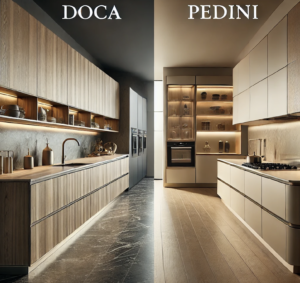
Who’s cabinets are these anyway…?
Did you know that just like the automobile industry, or the banking sector, kitchen companies (especially in Europe, but also in the US and other parts of the world) may actually be owned by another company or are a part of a large group that owns several brands?
Why does it matter you ask? Many times it really doesn’t matter – companies buy other companies because it makes a perfect business sense. They can improve profitability through integration and reduce costs at the same time, thus improving their bottom line. But what if you’re comparing two products, that are actually manufactured by the same company, with a few minor details changed and are being asked to pay much more just for a name? Sometimes, it is even made in the same factory… Now you may be asking: “Why would a company do that?” Here are a few possible reasons:
- Increase distribution – they can add more dealers, selling similar products, many times, in the same areas, with the same reps, without increasing overhead and without their existing dealers complaining about another dealer, selling the same product, too close to them.
- Be their own competition – they don’t care who you buy from, as long as it is one of their brands…
- Branching to another price level, that their present product doesn’t reach, without jeopardizing their present product sales and risking an image.
- Rather than building a distribution for their existing products in a new country, acquiring another brand that is already being distributed and just adding theirs to the existing dealers network, can be an easy solution.
How is that different from a company that has different models? A company that has different models, is usually offering ‘good, better, best’ options, based on materials, finishes and/or options that are available in each model. Here, we are talking about either a) Products that are sometimes so similar, the companies can actually switch the brand plates on the drawers and we wouldn’t know the difference…; or b) investing lots of money in a fancy brand name, that could be nothing more that that – a name…
Here are a few examples:
The Alno Group – a few years ago, it aquired the Wellmann Group, which years prior to that, aquired brands like Geba, Tielsa and StarBeka, to name just a few. There was so much overlapping in their offerings, that they ended up phasing these brands, one after another. A few years later, they were acquired by the Alno group and went through another round of phasing out brands. Still today, the group has some overlapping and in some parts of the world, they are selling a couple of brands, under the Alno label, though it is not an Alno kitchen…
The Colombini Group, from San Marino – their deep pockets, allowed them in recent years to take-over struggling companies, like Febal and Rossana. They are now made, in the same factory and are pretty much the same product with quite a bit of overlapping in their offerings. Last year, they have purchased the name Salvarani, after the company went out of business. Why buy just a name…? maybe because the brand name is still so strong in some markets (like Spain, for example)…
Scavolini Group – few people know that Ernestomeda, is actually Scavolini’s higher end line. It was launched in 1996, is made very similar to the Scavolini product, with a few minor changes (mainly the doors) and is marketed as another brand all together, attempting to target a higher end clientele.
The above is very important to kitchen dealers but could also be very interesting to a consumer, who may be trying to decide between brand A and brand B…
Recession winds are blowing in the kitchen…
We already know that the kitchen industry is not recession proof. Though most companies have held up pretty well so far, we are starting to some some cracks in the road to recovery. Some are pretty wide and deep…
The companies who seem to be effected the most, by the world recession, are a few of the largest companies. Perhaps their sheer size, makes it so much harder to adjust to though times and make the unnecessary adjustments quickly.
If you look at the 10 largest European Companies, you can see the effect of the global economy – Nobia, the largest European kitchen group (at least in 2009), already sold off Pronorm in 2010 and is now reported to pull out their Poggenpohl brand from the up coming Eurocucina…
One other German industry giant – the Alno Group, is also reported to be in rough waters. The ever so needed capital, from new Swiss investor, Mr. Max Muller is hopefully going to help the company who has reportedly have gone through several changes in middle and upper management lately and allegedly is in the middle of a pending law suit by the previous CEO over compensation.
In Italy, the recent bankruptcy of the 50+ year old Salvarani and the rumors of many brands in financial difficulties have the industry in buzz…
It will be very interesting to see what the Milan Fair and the Eurocucina show will look like next April. Rumor has it that Cosmit, who is the organizer of the show, is working very hard on convincing companies to return to the show next year.
SplinterWorks – Functional Sculpture
Formed in 2009, by Miles Hartwell and Matt Withington and located just south of London, SplinterWorks is one of the best examples of ‘applied arts‘ I’ve seen in recent years. They have delivered projects all over the world, in the USA, UAE, Southern Ireland, Cyprus, France, Italy and even one in Australia.
SplinterWorks have a particular affinity with developing work that re-thinks how we prepare, cook and experience food. They bring the activities of the kitchenout of the grid shaped room at the back of the house and into the living areas creating works to be enjoyed socially, physically and visually.
The majority of their works are unique commissions where every element, from the intended location and practical elements, to striking a personal resonance with the commissioner, can be considered and accomplished.
cunKitchen … take your kitchen to where you live
you don‘t need much to do something right… and even less to do it wrong. paulBocuse
cunKitchen … take your kitchen to where you live
onto your terrace, to your garden, alongside your swimming pool, and – last but not least – in your kitchen … or use it …for elegant front cooking, the professional demonstration kitchen and exclusive event cooking.
the versatile combination possibilities make cunKitchen become a mobile kitchen not bound to a static room. … whether classic gas or innovative induction technique, there are teppanYaki griddle, hob, oven, fridge and sink … … available in european hornbeam, teak, white corian®, or full stainless steel
cunKitchen … a modular system … for your inviduality
joko is a family run company of industrial – handcraft manufacture in the south tyrolean alps in Italy

the versatile combination possibilities make cunKitchen become a mobile kitchen not bound to a static room
the team of Josi and franz Kosta, who have been supplying butcher blocks, cutting boards and working tables to the professional market, under the Joko brand, have brought their passion for the kitchen, to the domestic market, several years ago.
my personal top 20 European kitchen brands
After many requests and lots of diliberations I’ve decided to post my own top 20 European brands. Top 20 European kitchen companies, because I simply felt that there are too many great European kitchen brands to limit the list to just top 10.
My Top 20 is based on the following criteria’s:
- DESIGN – overall product design, esthetics and selection depth (colors, materials, design elements, etc.).
- PRODUCT INNOVATION – is this a kitchen brand that takes risks, that is on the cutting edge of technology and innovates or just a company that copies others?
- PRODUCT QUALITY – how well made is the product? Does the company ‘cuts corners’?
- SERVICE – delivery on time, delivers complete orders, ‘after sale’ service, etc.
I have chosen not to take into consideration COMPANY SIZE, as there is no real direct benefit to the buyer and I’ve already listed the 10 largest European brands.
I also did not factor VALUE because I feel that value is very individual – what one consumer sees as a great value, another may view as cheap. Webster’s definition of Value is – “a fair return or equivalent in goods, services, or money for something exchanged”. Once a kitchen brand has top design, innovation, quality and service, the price will always be higher. Surprizingly, there are a few kitchen brands on this list that have a pretty good value, as well as ranking high on all the other categories.
In the Top 20 European Kitchen 11 Italian kitchen brands, 7 German kitchen companies, one English and one French are in the above list.
So, without further a due and in alphabetical order here are my Top 20 European kitchen Brands:
- Allmilmö
- Arclinea
- Binova
- Boffi
- Bulthaup
- Dada
- Eggersman
- Häcker
- Mobalpa
- Pedini
- Poggenpohl
- Schiffini
- SieMatic
- Smallbone
- Snaidero
- Strato
- Toncelli
- Valcucine
- Varenna
- Zeyko
- European Kitchens at the Top
- The Top Twenty European Kitchen Companies
Honorable mentions: there were a few companies that did not make it to my Top 20 European Kitchen Brands, but deserve a mention. Also in the advise of one of the readers of this blog, i’ve decided to update this post and add a few more (they deserve it!). We’ll call this section the “hors catégorie” (thanks Pierangelo):
Clive Christian – ranked high on DESIGN and if marketing was a category, will most definitely be included in the Top 20 list.
Marchi – ranked very high on DESIGN and INNOVATION.
Minotti – one of the best in creating the very unique, minimalist and clean look, that goes beyond a kitchen design. Not for everyone and is available only in selected few locations worldwide but Minotti is at the top of the DESIGN category.
LaCornue – though they are really more of an appliance company (ranges, cook tops, etc.) , they do offer cabinets and other elements that allow them to complete a kitchen. Very unique DESIGN, perhaps a trend setter in the high end appliance arena, with HIGH QUALITY products.


